

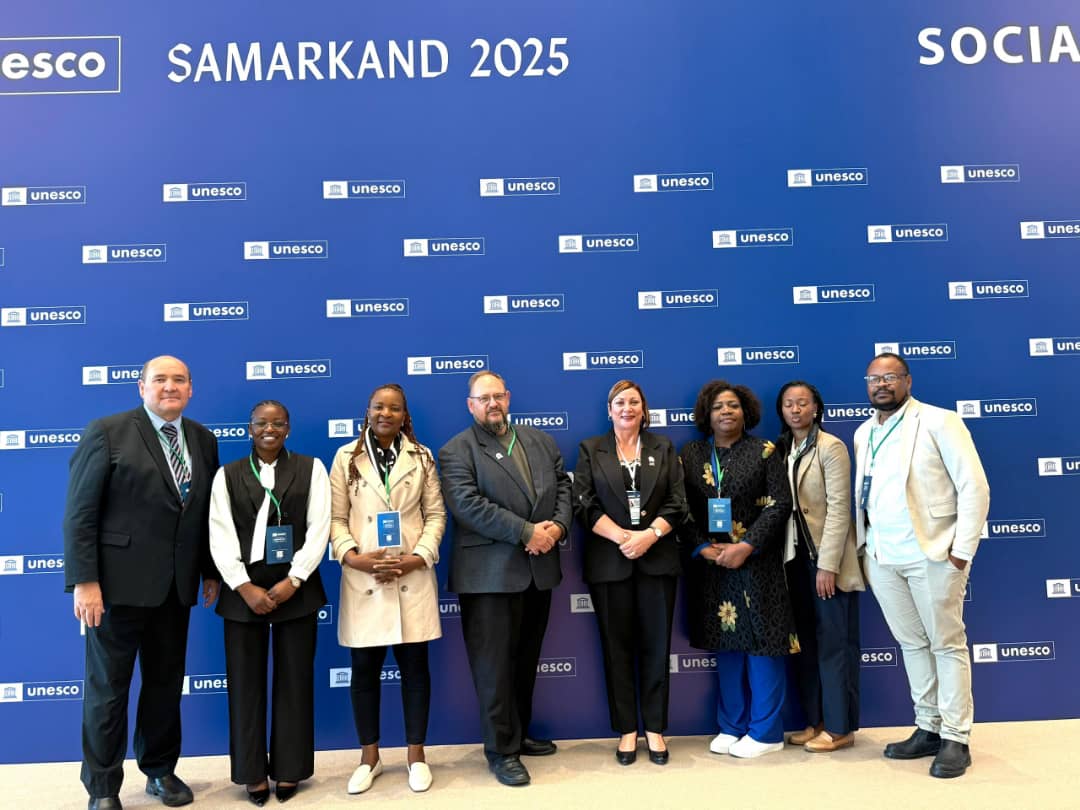
During the first week of the 43rd Session of the UNESCO General Conference, various meetings took place including the General Policy Debate (GPD), the Education Commission, the Administrative and Programme Commission (APX), the Nominations Committee, the Legal Committee as well as several side events.
UNESCO currently has 194 Member States. Each is invited to participate in the General Policy Debate, which is one of the first items on the agenda of the General Conference. The purpose of the GPD is for Member States to highlight priorities within UNESCO’s fields of competence and to identify emerging challenges the organisation might face in the future. Following these interventions, the Director-General of UNESCO responds to issues raised during the debate.
Honorable Sanet Steenkamp, Minister of Education, Innovation, Youth, Sports, Arts and Culture and Chairperson of the Namibia National Commission for UNESCO, delivered Namibia’s national statement on 3 November 2025. A report on the Director-General’s reply to the debate will follow in due course.
The Education Commission concluded its work on 4 November with discussions focused on the global and regional coordination of the SDG 4 agenda including teacher transformation, foundational learning, inclusive education, and the proposed revision of the 1966 and 1997 Recommendations on the Status of Teachers and Higher Education Teaching Personnel. From today, the Communication and Information (CI) Commission and the Social and Human Sciences (SHS) Commission commenced to with respective sessions which will run over the next three days and Namibia will participate in both.
The Nominations Committee received submissions from Member States for the various elective offices, commissions, and intergovernmental committees of UNESCO. The Committee compiled a consolidated list of nominations for election to bodies such as the Executive Board and other statutory organs of the organisation. The Administrative and Programme Commission (APX) also met this week to deliberate on issues concerning the administration, finance, governance, and management of UNESCO.
Two major agenda items under discussion were the Draft Programme and Budget for 2026–2029 (document 43 C/5) and the review of the audited financial statements submitted by the External Auditor. The Legal Committee examined the Letters of Credentials submitted by Member States for participation in the General Conference. These letters are required to confirm that delegates are duly authorised to represent their respective countries in the proceedings. Namibia submitted its original Letter of Credentials before the opening of the General Conference, in accordance with established procedure.
On 4 November, the Namibian delegates also attend side events, these included a presentation by the Türkiye Culture and Heritage Foundation on Türkiye’s Cultural Heritage and the World Turkic Language Family Day, as well as a dedicated side event reviewing the status of ratification of the Global Convention on the Recognition of Qualifications concerning Higher Education (UNESCO, 2019).
The latter session brought together Ministers and Deputy Ministers of Education from ratifying countries, senior UNESCO officials, and representatives from the international higher education community to discuss progress in implementation.


