

Windhoek, Feb 6 –Late President Hage Geingob was born in Otjiwarongo, South West Africa (present-day Namibia), on 3 August 1941. He received his early education at Otavi in South West Africa under the Bantu Education System. He joined the Augustineum, where most of today’s prominent political leaders of Namibia were educated, in 1958.
In 1960, he was expelled from the Augustineum for having participated in a march in protest at the poor quality of education. He was, however, readmitted and finished the teacher-training course in 1961. Subsequently, he took up a teaching position at the Tsumeb Primary School in Central Namibia but decided that he could not continue his further education in Namibia.
 | |||
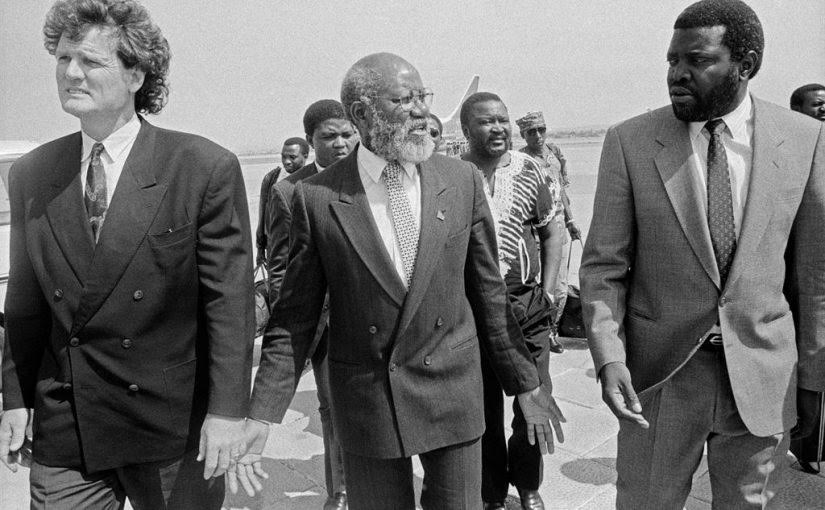
The late Andimba Toivo ya Toivo, late President Hage Geingob, and Cde Anton Lubowski on 18 June 1989 in Mozambique.
Therefore, at the end of the school year, he left his job to seek knowledge and instruction that could help him change the system. He and three of his colleagues walked and hitchhiked to Botswana to escape the system. From Botswana, he was scheduled to go to Koqua in Dar es Salaam, Tanzania, on a plane chartered by the African National Congress (ANC), but the plane was blown up by South Africans.
However, the bomb that had been planted on the plane went off prematurely, before the plane was able to take off. Subsequently, the apartheid regime also tightened up the “underground railway”. As a result, Geingob stayed in Botswana, where he served as Assistant South West Africa People’s Organization (SWAPO) Representative (1963–64).
EDUCATION
In 1964, Hage Gottfried Geingob embarked on his educational journey in the United States, enrolling at Temple University in Philadelphia, Pennsylvania, where he was granted a scholarship. His pursuit of knowledge continued, culminating in the attainment of a Bachelor of Arts (BA) degree from Fordham University in New York City in 1970. Geingob furthered his academic achievements with a Master of Arts (MA) degree in International Relations from the Graduate Faculty of The New School in New York in 1974.
During this period, Geingob’s commitment extended beyond academic pursuits. In 1964, he was appointed as the SWAPO Representative at the United Nations and to the Americas. Serving in this capacity until 1971, Geingob undertook extensive travels, crisscrossing the United States, engaging with people, and addressing gatherings.
Hage Geingob received his Ph.D. from the University of Leeds. His thesis was entitled “State Formation in Namibia: Promoting Democracy and Good Governance”. In his thesis, he examined significant events in the process of state formation in Namibia and provided insight into the role played by various actors involved in shaping the evolution of Namibia as a state.
FAMILY
Hage Gottfried Geingob’s family life has been marked by various relationships and marriages. His first two children were Sékou Touré Mangaliso Fernandez and Nangula Axabis Geingos. However, on January 23, 1967, he married Priscilla Charlene Cash, also known as Meme Niilonga, a native New Yorker. They had one daughter, Nagula Geingos-Dukes.
Later, he entered into a high-profile marriage with businesswoman Loini Kandume on September 11, 1993, in Windhoek, resulting in the birth of a daughter and a son. However, Geingob initiated divorce proceedings against Kandume in May 2006, and a provisional divorce order was granted in July 2008. On February 14, 2015, Geingob married Monica Kalondo, marking another chapter in his personal life.
Beyond his political career, Geingob was known for his passion for football, regularly attending high-profile games. He also actively participated in cultural events, being a regular attendee of the Namibia Annual Music Awards (NAMAs). In his youth, he was involved in the arts, singing in a choir and playing in a band.
POLITICS
In 1972, Geingob was appointed to the United Nations Secretariat as a political affairs officer, a position he held until 1975 when he was appointed director of the United Nations Institute for Namibia. He and his team were responsible for initiating the institute, with its primary function being to train cadres capable of assuming roles in the civil service of Namibia upon independence.
Another essential aspect of the institute was conducting sectoral research to develop a policy framework for the government of independent Namibia. Over the years, it gained prominence, establishing institutional relations with various European higher learning institutions, including the University of Warwick, the University of East Anglia, and the University of Sussex. These institutions recognized the institute’s diploma, admitting its graduates for further studies.
Geingob served as the director of the United Nations Institute for Namibia until 1989. Concurrently, he remained a member of both the Central Committee and the Politburo of SWAPO. Constituent Assembly In 1989, the Politburo of SWAPO elected him to lead SWAPO’s election campaign in Namibia.
To fulfill this role, he returned to Namibia on June 18, 1989, after a 27-year absence. As SWAPO’s Director of Elections, Geingob, alongside his directorate, established SWAPO election centers nationwide, playing a crucial role in bringing SWAPO to power in Namibia.
On November 21, 1989, following the elections, he was elected chairman of the Constituent Assembly, responsible for formulating the Namibian Constitution. Before drafting the constitution, he focused on building confidence among the people, who were historically divided. Subsequently, national reconciliation became government policy, and under Geingob’s chairmanship, the Constituent Assembly unanimously adopted the Namibian Constitution on February 9, 1990.
On March 21, 1990, Geingob was sworn in as the first Prime Minister of the Republic of Namibia. He served in this capacity for 12 years, being sworn in for a second term on March 21, 1995. As prime minister, Geingob introduced modern management approaches to the government, emphasizing nature conservation coupled with tourism. In the early 1990s, he opened the Ongava Lodge, just south of Etosha National Park.
In a cabinet reshuffle on August 27, 2002, Geingob was replaced as prime minister by Theo-Ben Gurirab and appointed Minister of Regional and Local Government and Housing. However, he declined to accept this lesser position. Despite being the ninth-highest vote earner in the election to the central committee of SWAPO in August 2002, Geingob failed to be reelected to the SWAPO politburo on September 15, receiving 33 votes out of 83.
In 2003, Geingob accepted an invitation to be the Executive Secretary of the Global Coalition for Africa based in Washington, D.C. The Global Coalition for Africa is an intergovernmental forum focusing on Africa’s priority development issues, with Geingob working toward conflict resolution, good governance, and the integration of African economies into the global economy.
Return to Parliament In the nomination of SWAPO parliamentary candidates on October 2, 2004, Geingob, then still in Washington working for the Global Coalition for Africa, placed 28th out of 60. Subsequently, he left the Global Coalition for Africa and returned to Namibia to participate in the November 2004 parliamentary election, winning a seat.
Swearing-in of President Hage Geingob (2015) On April 18, 2007, Geingob became the party Chief Whip of SWAPO in the National Assembly. He re-entered the SWAPO politburo in mid-2007, filling one of two vacancies. In November 2007, a few weeks before a party congress, the politburo named Geingob its sole candidate for the position of vice-president of SWAPO. At the congress, he was elected without opposition on November 29, 2007, and appointed Minister of Trade and Industry on April 8, 2008.
At SWAPO’s 2012 party congress, Geingob was reelected as vice president on December 2, positioning him as the likely successor of Hifikepunye Pohamba as president of Namibia in 2015. Following the congress, Pohamba appointed Geingob prime minister on December 4, 2012.
Geingob, as the SWAPO candidate, was elected President of Namibia with an overwhelming margin on November 28, 2014, receiving 87% of the vote. He was sworn in as president on March 21, 2015. During his first term, he implemented social programs for the elderly and advocated for the development of renewable energy, although poverty alleviation remained a significant challenge.
In December 2016, Geingob challenged the United States to join the International Criminal Court to reassure African nations that the court is not targeting Africans. He chaired SADC after being elected to the position in 2018. In November 2019, Geingob was reelected with 56.3% of the vote. In April 2021, reports emerged linking Geingob to the Fishrot scandal, alleging his involvement in diverting funds from a state-run fishing company to bribe attendees of the 2017 SWAPO electoral congress.
In February 2023, Geingob hosted First Lady of the United States Jill Biden, the highest-level U.S. official to visit Namibia since Al Gore in 1996. In March 2023, Geingob named Netumbo Nandi-Ndaitwah as the Swapo Party’s candidate in the next year’s presidential election.
DEATH
In January 2024, Namibian President Geingob supported South Africa’s ICJ genocide case against Israel, criticizing Germany for supporting Israel while referencing Germany’s role in the Herero and Nama genocide. On 8 January 2024, the president’s medical doctors disclosed that Mr. Geingob was diagnosed again with cancer after a colonoscopy and a gastroscopy.
He was given an offer for novel treatment by Isreali-linked doctors and scientists in Los Angeles, US. He subsequently went for brief cancer cell-based immunotherapy treatment in the United States on 25 January and returned to Namibia on 30 January following two days of treatment. On 4 February, the State House announced that Geingob had died at Lady Pohamba Hospital in Windhoek, where he had been receiving treatment.
Vice President Nangolo Mbumba was formally sworn into office as acting President of Namibia at a hastily arranged ceremony at State House in Windhoek, about 15 hours after Geingob’s death. A government spokesperson said that Mbumba would serve the remainder of Geingob’s term, which expires on 21 March 2025.
Throughout his tenure, President Hage Geingob maintained positive relations with various countries, fostering diplomatic ties with nations such as the United States, China, and Russia. However, he has been known to be a critic of the West, expressing reservations or criticisms about certain Western policies or actions. This nuanced approach to international relations reflects Geingob’s commitment to maintaining a balanced and independent foreign policy for Namibia.


