


Byron Adonis Mutingwende2 Minutes Ago03 Mins
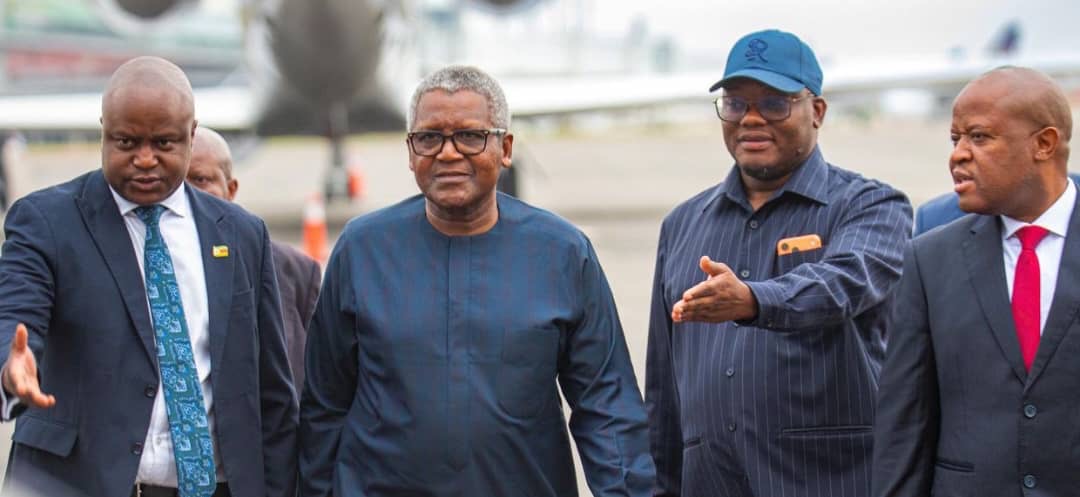
(L-R) Tatenda Hungwe, Aliko Dangote, Dr, Tungwarara, and Senziwani Sikhosana
(L-R) Tatenda Hungwe, Aliko Dangote, Dr, Tungwarara, and Senziwani Sikhosana
Africa’s richest man, Aliko Dangote, is breathing new life into Zimbabwe’s investment revival efforts under the Second Republic led by President Emmerson Mnangagwa, whose government is leaving no stone unturned in the quest to make the country an upper-middle-income economy by 2030.
The billionaire arrived in Harare this morning to seal a US$1 billion industrial investment deal. This is a landmark development poised to reshape Zimbabwe’s manufacturing and energy landscape.
The visit, which has stirred excitement across the economic and business community, is set to culminate in the establishment of an integrated industrial complex comprising a cement plant, coal mine, and power generation facility.
Together, these components will form one of the largest private-sector investments in Zimbabwe in recent years, symbolising a decisive step toward national industrialisation and energy self-sufficiency.
Dangote’s arrival was marked by a high-level reception that underscored the gravity of the partnership. At the airport to welcome him were the key figures behind the deal. These were Presidential Investment Advisor Dr. Tempter Paul Tungwarara, Bard Santner CEO Senziwani Sikhosana, and Josey Mahachi, who has long served as a bridge between Zimbabwe and the Dangote Group.
Their presence reflected a deep alignment between public policy priorities and private enterprise vision, a hallmark of President Emmerson Mnangagwa’s #Vision2030 agenda, which seeks to transform Zimbabwe into an Upper Middle Income Economy within the decade.
“This collaboration shows that Zimbabwe is open for transformative partnerships that deliver tangible industrial outcomes. It’s not just an investment. It’s a catalyst for job creation, skills transfer, and sustainable economic growth,” said Dr Tungwarara.
If fully implemented, the Dangote Industrial Complex will be designed as a fully integrated hub, allowing local value addition across the cement, energy, and mining supply chains.
The cement plant will reduce reliance on imports and expand infrastructure development capacity.
The coal mine will provide energy security for industrial operations and feed into the national grid.
The power station will help stabilise the electricity supply for surrounding industries and communities.
The project is expected to generate thousands of direct and indirect jobs, stimulate local enterprise development, and strengthen Zimbabwe’s position as a regional manufacturing player.
According to investment analysts, this deal represents more than capital inflow. It signals renewed investor confidence in Zimbabwe’s economic trajectory and policy reforms.
“Dangote’s decision to invest is a vote of confidence in Zimbabwe’s industrial potential. It positions the country to re-emerge as a Southern African production hub,” one of the economists who spoke to this publication said.
Aliko Dangote, whose Dangote Group operates across 10 African nations, is no stranger to building transformative infrastructure. His ventures, from the world’s largest single-train oil refinery in Nigeria to multiple cement plants across the continent, embody a mission to drive African self-sufficiency in core industries.
His Zimbabwe venture aligns perfectly with that mission.
“Industrialisation is the backbone of Africa’s development. When we produce locally, we create prosperity locally,” Dangote said.
With the Zimbabwe project, Dangote extends that philosophy into southern Africa, marking what could become a cornerstone of regional economic integration.
As discussions move toward finalisation, expectations are high that ground-breaking will commence in 2026, pending regulatory approvals and final technical assessments. The initiative is also expected to draw complementary investment in transport, logistics, and housing infrastructure around the project site.
For Zimbabwe, the timing could not be better. With global investors gradually returning and the government pushing for industrial diversification, Dangote’s billion-dollar move represents both a validation of policy and a vision of progress.
Spiked Media


