


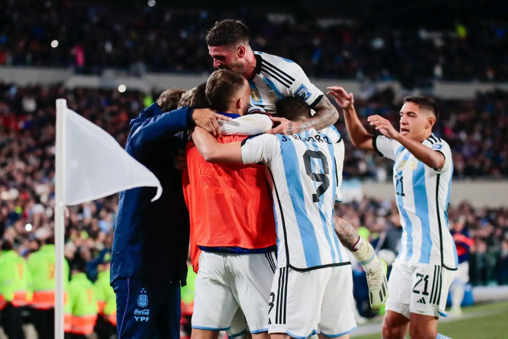
NEW YORK, July 18 — Sunday’s World Cup final at New York New Jersey Stadium will bring together the top two ranked teams in the world and two contrasting approaches to the game.
Argentina, the world’s No. 1 team on the FIFA rankings, is bidding to become only the third nation to defend football’s most coveted trophy, after Italy in 1938 and Brazil in 1962. Spain, ranked second, is chasing a second title, 16 years after its first. For eight-time Ballon d’Or winner Lionel Messi, it will be a third World Cup final, equaling the record held by Brazilian Cafu for final appearances. Pele won three titles but played in only two finals, sidelined by injury in 1962. Should the 39-year-old Argentina captain score, he would join five other men who have done so in two different World Cup finals, a list that includes Kylian Mbappe, Zinedine Zidane and Pele.
Facing him will be 19-year-old Lamine Yamal, the Barcelona forward many see as an heir to Messi’s throne. The pair have never played against each other on a football pitch. A 2007 photograph showing Messi holding Yamal as a baby, taken during a charity event, has become one of the tournament’s most-shared images. Spain arrives having conceded just one goal in seven games, fewer than any previous World Cup winner managed across a full campaign.
Head coach Luis de la Fuente has built a team on patient ball control, averaging 63.7% of possession in its matches throughout the tournament. That dominance is backed by an aggressive press led by midfielder Rodri and a high defensive line that has constantly unsettled opponents. Argentina took a rockier route to the final, surviving scares against Cabo Verde, Egypt and Switzerland before edging England in the semifinals. Twelve of its 19 goals have come after the 75th minute, testament to a side characterized more by resilience and unyielding spirit than outright superiority. Messi remains central to it all, sharing in 12 of those 19 goals himself, through eight goals and four assists. Argentina remains dangerous in the air despite being one of the shorter squads at the tournament, scoring four headed goals, three of them created by Messi crosses.
Rodri, along with central defenders Aymeric Laporte and Pau Cubarsi, will be key to restricting Messi’s space. Left-back Marc Cucurella must also remain alert for occasions when Messi drifts to the right, a tactic he used to devastating effect against England in the semifinals and Egypt in the round of 16. There are duels elsewhere too. Yamal’s explosive dribbling down Spain’s right caused problems for France’s Lucas Digne in the semifinal. Argentina left-back, likely Nicolas Tagliafico, may face a similar test on Sunday.
Meanwhile, Cucurella and Pedro Porro – should he recover from muscle tightness – could also cause problems for Nahuel Molina and Tagliafico with their attacking bursts. Cucurella has shown his offensive qualities with regular runs behind opposition lines, while Porro has scored twice throughout the tournament. Spain also carries a scheduling edge, having played its semifinal on Tuesday, a day before Argentina beat England. Teams with the extra day of rest have prevailed in the large majority of recent World Cup and UEFA European Championship finals, across both men’s and women’s football.
The match will be the sides’ first competitive meeting since a 2018 friendly, when Spain crushed a Messi-less Argentina 6-1 in Madrid. Whatever happens, Sunday’s final promises a fitting juncture between the game’s present and its next chapter.
Xinhua


