


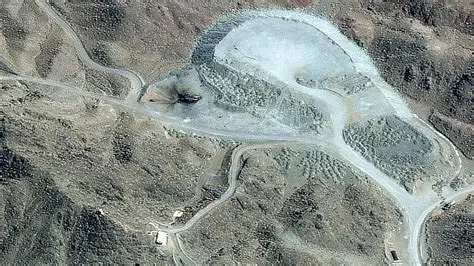
CAIRO, July 23– Tensions between Washington and Tehran have escalated in recent days, with Pickaxe Mountain — a fortified site near Iran’s Natanz enrichment facility — emerging as the confrontation’s new flashpoint. Threats from Washington to strike the fortified underground complex have widened the rift between the two sides, stoking fears of renewed instability across the Middle East.
WHAT HAPPENED?
As the United States and Iran continued their exchanges of strikes for several days, U.S. President Donald Trump warned on Tuesday that Washington was prepared to strike Pickaxe Mountain “very soon” and “very heavily.”
The threats followed reports, citing Israeli intelligence assessments, that Iran may have moved advanced uranium-enrichment centrifuges into the underground complex. However, when asked whether Iran had relocated centrifuges to the site, Trump said the United States did not have that information “on record.” Tehran has rejected allegations that the site represents an undeclared nuclear facility, saying the complex was declared to the International Atomic Energy Agency in 2020 as the future site of an advanced centrifuge assembly plant. In response to U.S. threats, Iran’s Khatam al-Anbiya Central Headquarters warned on Wednesday that any U.S. attack on nuclear or other sensitive sites would be treated as an expansion of the conflict and would trigger strikes against U.S., allied and partner interests across the region. In a separate statement on Wednesday, the headquarters warned that if the United States attacks Iranian infrastructure, Iran will block all oil exports from West Asia and target oil, gas, electricity and economic infrastructure across the region, according to media reports. Experts say the latest exchange of threats reflects a cycle of pressure and deterrence, cautioning that further escalation could complicate efforts to address differences between the United States and Iran through diplomacy.
WHY PICKAXE MOUNTAIN MATTERS?
Pickaxe Mountain has become a key focus in discussions over Iran’s nuclear infrastructure due to its location, design and level of protection.The underground complex is located in central Iran, roughly 2 km from the Natanz nuclear facility. Construction reportedly began after a 2020 explosion damaged Natanz’s above-ground advanced centrifuge assembly plant. Iranian officials have said the underground complex was built to protect nuclear infrastructure from possible sabotage or military attacks. Mostafa Amin, an Egyptian researcher on Arab and international affairs, said the project reflects Iran’s efforts to strengthen protection for key nuclear facilities. Assessments by nuclear experts and non-proliferation researchers indicated that parts of the facility are located deep underground beneath layers of rock and reinforced structures, making them among the deepest and most heavily fortified nuclear-related facilities publicly known, Amin said. The lack of international access to some parts of the site has contributed to differing assessments of its purpose. Western and Israeli officials argue that the underground complex could provide greater protection for sensitive nuclear activities, while Iran maintains that its nuclear program is peaceful.
COULD A U.S. STRIKE SUCCEED?
Although Washington has vowed to strike Pickaxe Mountain, experts say a potential U.S. military strike would face significant technical hurdles. Abu Bakr al-Deeb, an advisor at the Cairo-based Arab Center for Research and Studies, said the depth and reinforced structure of the underground complex would present major challenges for any military operation. “The underground halls are believed to be located at a depth that could challenge the effectiveness of conventional bunker-busting weapons, including the Massive Ordnance Penetrator,” al-Deeb said. He said an aerial operation might damage entrances, ventilation systems and supporting infrastructure without necessarily destroying the core underground facilities.
While a complete destruction of Pickaxe Mountain is considered highly unlikely, a U.S. military strike against the facility would represent a significant escalation in the already tense confrontation between the two countries. Al-Deeb warned that military action could expand instability beyond the immediate target, potentially drawing additional parties into the conflict, disrupting maritime trade routes and threatening global energy supplies. Echoing al-Deeb’s assessment, Amin said continued reliance on military pressure could undermine diplomatic efforts to resolve differences over Iran’s nuclear program. “It could heighten regional tensions, increase the risk of wider confrontation and further complicate international non-proliferation efforts,” Amin added.
Xinhua


