

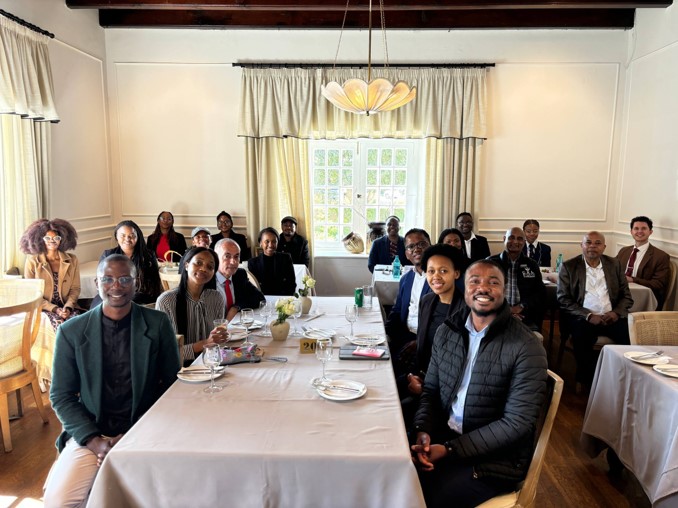
Windhoek, July 22 –18 July 2026 on Nelson Mandela International Day, designated by the United Nations to honor the
values of human rights and social justice, legal practitioners and academics gathered voluntarily at Olive & Plates in Johannesburg for a comparative-law roundtable and civil campaign. Operating as a grassroots initiative without a singular institutional host, the gathering aimed to honor Mandela’s legacy by examining the relationship between human dignity, international law, and the rule of law from a civil society perspective.
Conducted as an informal yet focused roundtable dialogue, the discussion allowed participants to exchange perspectives on the United Nations Standard Minimum Rules for the Treatment of Prisoners, commonly known as the Nelson Mandela Rules, alongside comparative legal approaches to migration, detention, and due process in South Africa and the Republic of Korea. Grounded in the belief that protecting human rights is a shared task for the entire international community, participants emphasized the necessity of addressing universal values beyond national boundaries.
During the session, the participants also reviewed the ongoing legal proceedings involving Chairman Man-hee Lee of HWPL, an international peace NGO headquartered in South Korea, from a humanitarian and legal perspective, with
reference to international human rights standards and the protection of fundamental rights.
This case has recently drawn the attention of the international legal community, having also been discussed by European scholars and human rights experts at the European Academy of Religion (EuARe) international conference in Rome on July 3.
The experts highlighted that the UN Mandela Rules explicitly recommend alternative measures to incarceration be considered first for elderly or seriously ill individuals.
Furthermore, noting that the UN maintains an Independent Expert on the Enjoyment of All Human Rights by Older Persons to guard against unjust treatment based on age or health, they observed that the treatment of a detainee of such an advanced
age warrants careful monitoring under international standards.
Dr. Rajendran T. Govender, Commissioner of the CRL Rights Commission, stated, “From what I know about Chairman Lee and his organization, which operates globally, no one can replace the profound work he has done in creating platforms for interfaith dialogue and building peace. Furthermore, the ongoing prosecution and detention he is facing appear to be an unjust measure. When someone is doing such magnificent work for peace in society, they should be supported, not imprisoned. I
believe the international community must unite to deliver a simple and powerful message to the South Korean government. They need to reconsider his lifelong commitment to peace, his advanced age, and his immense contributions to society,
and resolve this matter in an amicable way. Dialogue and harmony are the universal methods for human peace. I strongly urge the international community to speak out with a single, powerful voice.”
Adv. Desmond Brown, Senior Counsel of the Johannesburg Bar, added, “From the standpoint of the rule of law and human rights, I firmly believe there is clear room for a review of Chairman Lee’s continued detention. There needs to be a rigorous
evaluation of the genuine facts that may have led to the denial of bail for him. I earnestly call upon the Government of the Republic of Korea to reconsider its stance on his ongoing detention. The international community must engage in more
extensive advocacy for Chairman Lee’s release and adopt a more humanitarian approach to this case.”
The gathering concluded in the spirit of Mandela’s message—that changing the world begins with small actions taken wherever one stands. Reaffirming that due process and international cooperation form the foundation for safeguarding
fundamental rights, the participants expressed their commitment to maintaining cross-jurisdictional dialogue and continuing grassroots campaigns to protect human dignity.


