

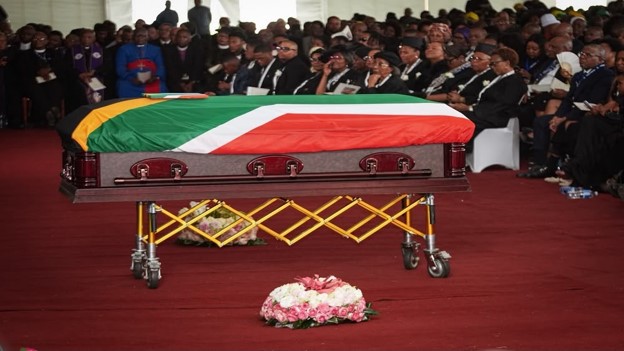
South Africa, Nov. 28 — African leaders, diplomats, former colleagues and women’s rights advocates have paid tribute to the late Dr Pumzile Mlambo-Ngcuka, celebrating her outstanding contribution to gender equality, women’s empowerment, peacebuilding, economic transformation and leadership across Africa and the world today at her funeral in Eastern Cape, South Africa.
Mlambo-Ngcuka, who served as South Africa’s former Deputy President and Executive Director of UN Women, was remembered as a courageous leader who dedicated her life to advancing the rights of women and girls, particularly young African women.
Speaking during the tributes, South African President Cyril Ramaphosa highlighted her commitment to ensuring that young women had a seat at decision-making tables, including opportunities to engage directly with heads of state and other influential leaders.
During her leadership at UN Women, she championed generational equality and built strong alliances, recognising that the struggle for gender equality required the participation of both men and women. However, she remained uncompromising when it came to protecting the rights of women and girls.
Her contribution also extended beyond gender advocacy, particularly through her involvement in peacebuilding efforts in Ethiopia, where her work in the peace process helped address immense human suffering.
Ramaphosa further praised Mlambo-Ngcuka for confronting historical inequalities in South Africa’s minerals and energy sector, particularly the exclusion of black South Africans from ownership and economic benefits derived from the country’s mineral wealth.
He said she took responsibility for an industry historically built on the dispossession of black people and the exploitation of black workers, many of whom came from different parts of the African continent.
According to Ramaphosa, the mining industry had largely been owned and controlled by a white minority, despite South Africa’s vast mineral resources and widespread poverty among its population.
Under her leadership, government developed the Mineral and Petroleum Resources Development Act and introduced the country’s first Mining Charter, which sought to broaden black participation in the mining industry and promote economic transformation.
Ramaphosa said these legislative reforms were intended to ensure that South Africans, particularly previously disadvantaged communities, had a rightful stake in the country’s mineral wealth.
The reforms also required mining companies to invest in their workers and communities surrounding their operations, as well as communities from which mineworkers originated.
Mlambo-Ngcuka was further celebrated for co-convening the African Women Leaders Network (AWLN), an initiative aimed at strengthening women’s leadership, mentorship and intergenerational collaboration across the continent.
Reading a message on behalf of former Liberian President Ellen Johnson Sirleaf, a representative of African women leaders described Mlambo-Ngcuka as a trailblazer whose influence transformed women’s leadership in Africa and globally.
Sirleaf, who is the patron of the African Women Leaders Network, said her passing had brought shock and deep sadness to the movement, noting that her contribution to advancing women’s leadership was profound.
She pledged that the network would continue building on Mlambo-Ngcuka’s legacy, including naming future intergenerational dialogues and mentorship programmes in her honour.
Other speaker who spoke on behalf of the family recalled her humble beginnings in Clermont, KwaZulu-Natal, highlighting her journey from a young teacher to one of Africa’s most influential political and international figures.
Her commitment to friendship, mentorship and solidarity was also remembered, with colleagues describing how she generously shared her time, experience and wisdom with younger generations of women.
Former President Thabo Mbeki ‘s tributes reflected on her commitment to the African National Congress (ANC), with a call for honest reflection, accountability and renewed leadership to address the country’s challenges, including unemployment and poverty.
He stressed the need for more leaders who share Mlambo-Ngcuka’s dedication to improving the lives of ordinary people.
As tributes continue, her legacy stands as a reminder of the importance of inclusive leadership, women’s participation in decision-making, economic transformation and the responsibility to create opportunities for future generations.
Dr. Pumzile Mlambo-Ngcuka was laid to rest at a cemetery near her family home in Ann Shaw village, Middledrift (eXesi), Eastern Cape, South Africa, on Saturday, 28 November 2026.
Image Credit: GCIS


