


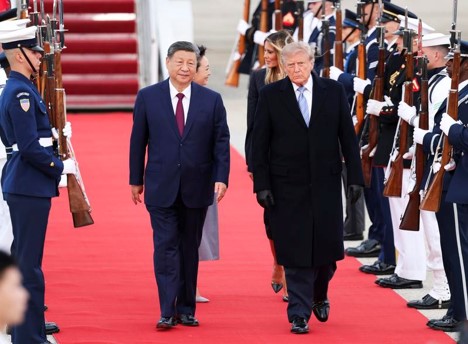
NEW YORK, Oct. 2 — A more stable U.S.-China relationship has effects well beyond the bilateral relationship because the two countries are deeply connected to the global economy and play major roles in international institutions and global governance, a renowned U.S. expert on China affairs has said.
In a written interview with Xinhua, Denis Simon, former senior adviser for China affairs to the president of Duke University, noted that Chinese President Xi Jinping said during the recent state visit to the United States that the great rejuvenation of the Chinese nation and making America great again can go hand in hand, complement each other and benefit the world. “I read this as an attempt to frame the relationship in terms of mutual national interests rather than as a zero-sum contest. Both China and the United States have their own national ambitions and domestic priorities, but those objectives do not necessarily require the other country to fail,” said Simon, who also served as executive vice chancellor of Duke Kunshan University in 2015-2020. “Rather than asking either side to abandon its own national goals, the message is that China’s development and America’s prosperity can coexist and, under the right conditions, reinforce one another,” he said.
Regarding the constructive China-U.S. relationship of strategic stability featuring cooperation as the mainstay, moderate competition, manageable differences and promises of peace, Simon described the formulation as “an effort to provide a practical framework for managing a relationship in which competition is unavoidable but conflict is not inevitable.” “The key phrase for me is ‘competition within bounds.’ It recognizes that China and the United States will compete in areas such as technology, trade and strategic influence. The objective is not necessarily to eliminate that competition, but to establish boundaries so that competition does not become confrontation,” he said. Simon said “manageable differences” acknowledges that some disagreements may be very difficult to resolve in the foreseeable future. A stable relationship, therefore, cannot depend on resolving every difference. “It needs mechanisms that allow the two sides to disagree without allowing individual disputes to destabilize the entire relationship,” he said. “If implemented consistently, the framework could shift the emphasis from trying to eliminate competition toward making competition predictable and manageable, while expanding cooperation wherever interests genuinely overlap.”
Simon identified economic and trade issues as an obvious area where concrete progress could have immediate effects, while noting that technology and supply-chain questions are more difficult “because they involve both economic and national-security considerations.” “But precisely for that reason, they require sustained dialogue and clearer communication,” he said, adding that beyond bilateral issues, cooperation on climate, energy, public health and other transnational challenges could demonstrate that competition does not have to prevent practical collaboration.
Xinhua proud partner of the African Youth Newspaper


