

By Rousa Shikoha
Windhoek, July 15 — History has a way of reminding us that the strongest relationships are often born during the most difficult times. They are not built overnight, nor are they sustained by ceremonies alone. They are strengthened through trust, mutual respect and a shared commitment to walking together through changing seasons. The relationship between Namibia and the People’s Republic of China is one such story.
For many Namibians, China is often associated with modern infrastructure, trade, scholarships and investment. Yet the story of this partnership stretches much further back than the buildings we see today or the agreements announced during official visits. It is rooted in a period when Namibia was still fighting for its independence, when international solidarity played an important role in supporting the country’s aspirations for freedom.
There is an African proverb that says, “A river does not forget its source.” Nations are no different.
Every partnership has a beginning. Some begin through geography. Others through commerce. A few begin during moments when history demands courage, solidarity and the willingness to stand beside one another. The relationship between Namibia and China belongs to that rare category.
The friendship between Namibia and China predates Namibia’s independence. During the liberation struggle, China was among the countries that extended political support to the South West Africa People’s Organization (SWAPO) as part of its broader engagement with African liberation movements. Those early interactions were founded on mutual respect and a shared belief in self-determination. Although separated by geography and culture, the relationship that emerged during those years laid the foundation for one of Namibia’s longest-standing international partnerships.
When Namibia attained independence on 21 March 1990, diplomatic relations between Namibia and the People’s Republic of China were formally established. What began as solidarity during the liberation struggle gradually evolved into a comprehensive partnership characterized by political dialogue, economic cooperation and people-to-people exchanges. Over the past thirty-six years, relations between the two countries have continued to deepen through regular engagements between governments, institutions and political parties, particularly between SWAPO and the Communist Party of China (CPC).
Like many enduring friendships, this partnership has evolved with time. What began through political solidarity has expanded into cooperation across education, healthcare, agriculture, infrastructure, mining, trade, science, technology and cultural exchange. Thousands of Namibians have benefited from scholarships, professional training and academic exchanges in China, while cooperation between institutions has supported Namibia’s national development priorities.
These achievements remind us that diplomacy is not only about presidents meeting across conference tables or officials signing agreements. It is also about students who return home with new knowledge, entrepreneurs who create employment, researchers who collaborate across borders and communities that benefit from improved healthcare, infrastructure and opportunities. In many ways, the true success of international cooperation is measured not by official communiqués but by the lives it touches.
Trade has also become a defining feature of the relationship. China remains one of Namibia’s largest trading partners and an important market for Namibian exports, while Chinese investment has contributed to infrastructure development, mining, energy and construction projects across the country. As Namibia pursues industrialization and economic diversification, cooperation that promotes investment, value addition, technology transfer and skills development continues to present important opportunities for sustainable growth.
In recent years, China’s development journey has attracted increasing international attention. Beyond its remarkable economic transformation, scholars, policymakers and development practitioners have sought to understand the governance approaches that have accompanied its rapid growth. Discussions frequently highlight long-term planning, institutional capacity, administrative efficiency, poverty reduction and sustained investment in education, infrastructure and innovation. These themes continue to shape global conversations about how countries pursue inclusive and sustainable development.
For Namibia, understanding international experiences is not about replicating another country’s political system. Every nation follows its own constitutional path and is shaped by its unique history, values and democratic institutions. Rather, examining different development models broadens perspectives, encourages constructive dialogue and provides opportunities to learn from experiences that may inform our own national priorities.
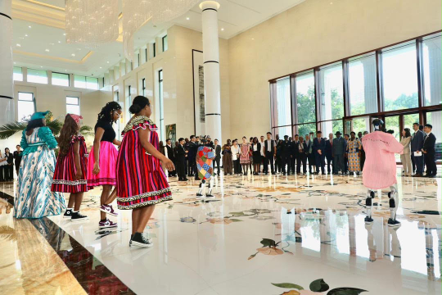
This broader context gives additional significance to President Dr. Netumbo Nandi-Ndaitwah’s recent State Visit to the People’s Republic of China. As Namibia’s first female President, the visit carried significance beyond diplomacy. It represented a historic milestone for Namibia while reaffirming a relationship that has continued to grow since independence. It also reflected the confidence of a nation entering a new chapter of leadership while maintaining a foreign policy rooted in friendship, mutual respect and international cooperation.
The visit was also significant because it was among President Nandi-Ndaitwah’s first major bilateral engagements beyond the African continent since assuming office. High-level discussions focused on strengthening cooperation in infrastructure, agriculture, renewable energy, mining, education, science, technology, trade and investment. These are sectors that align closely with Namibia’s development priorities under Vision 2030 and the country’s broader aspirations for economic transformation, industrialisation and job creation.
During the visit, both countries reaffirmed their commitment to expanding cooperation through agreements and continued dialogue aimed at creating practical benefits for their citizens. Particular attention was given to renewable energy, critical minerals, value addition, innovation, technology transfer and skills development. As global demand for minerals essential to the green energy transition continues to grow, Namibia finds itself well positioned to benefit from partnerships that encourage responsible investment while ensuring greater local participation and long-term economic value.
Equally important was the message the visit sent to the international community. As Namibia’s first woman Head of State, President Nandi-Ndaitwah’s engagement with one of the world’s largest economies demonstrated the country’s growing confidence on the global stage. It reinforced the idea that Namibia is not merely seeking investment, but building partnerships based on equality, mutual benefit and shared prosperity.
This year, China also commemorated the 105th anniversary of the founding of the Communist Party of China (CPC). Across official speeches and policy commentaries, the anniversary served not only as a reflection on the Party’s history but also as an opportunity to reaffirm commitments to reform, innovation, national rejuvenation and improving the lives of its people. Repeated emphasis was placed on strengthening institutions, maintaining close ties with citizens and preparing younger generations to contribute to the country’s future.
While every nation charts its own course, these discussions reinforce a universal principle: sustainable development requires long-term vision, capable institutions and continuous investment in people. They also highlight the importance of leadership that looks beyond immediate challenges and plans for future generations.
For Namibia, the opportunities are considerable. As the country positions itself to become a leader in renewable energy, green hydrogen and the responsible development of critical minerals, partnerships that encourage investment, innovation, education and technology transfer will become increasingly important. Equally important is ensuring that these partnerships create jobs, strengthen local industries, develop skills and empower young Namibians to participate meaningfully in the country’s future economy.
The future of the Namibia – China relationship will not be defined solely by diplomatic milestones or official visits. Its enduring significance will be measured by the opportunities created for young people, the knowledge exchanged between institutions, the businesses that grow through cooperation, the innovations that solve local challenges and the communities whose lives are improved through meaningful partnerships.
History has already written the first chapters of the Namibia – China story. They speak of solidarity, friendship and shared aspirations during a defining period in Namibia’s struggle for independence. Today’s chapter is different. It is being written through development, education, innovation, trade and economic cooperation.
As I reflect on the journey that has brought Namibia and China together, one thought remains clear: the strongest partnerships are not those that simply withstand the passage of time, but those that continue to find new purpose with each generation. History gave our two nations a foundation built on solidarity and mutual respect. The responsibility now rests with us to ensure that this foundation continues to create opportunities for future generations.
As Namibia’s first female President leads the country into a new era, and as China continues pursuing its long-term development ambitions, the future of this partnership will ultimately be measured not by the number of agreements signed or the ceremonies that accompany them, but by the opportunities they create for ordinary people. It will be seen in the student who returns home with new knowledge, the entrepreneur who builds a successful business, the researcher who develops innovative solutions, the community transformed through infrastructure and the young Namibian whose future is shaped by education and opportunity. History may have introduced Namibia and China to one another, but it is the choices we make today in education, innovation, dialogue and cooperation that will determine how future generations tell the next chapter of this remarkable story.


