


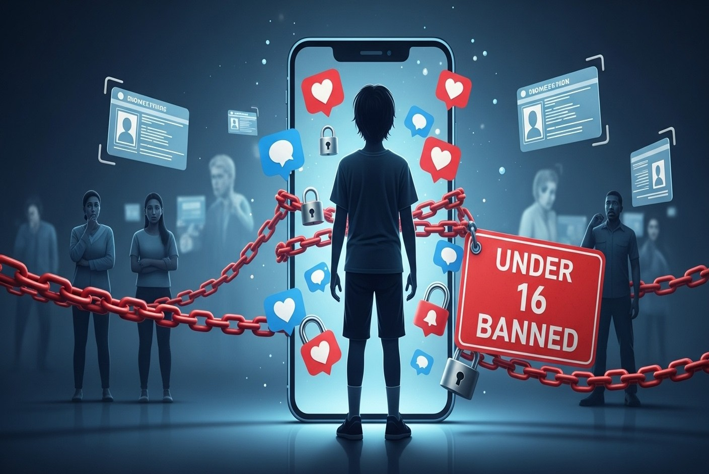
LONDON, June 17 — British Prime Minister Keir Starmer’s plan to ban children under 16 from social media has drawn fresh attention to online child safety, with experts warning that its impact will depend on enforcement, platform design and support beyond the ban itself.
The government said Monday that the measure would follow Australia’s model, covering platforms built around social interaction, content posting and algorithmic recommendation. It also plans to implement default restrictions for 16- and 17-year-olds, while considering overnight curfews and breaks in infinite scrolling for under 18s. The restrictions will take effect from spring 2027.
BEYOND THE BAN
However, experts said the policy’s impact would depend on whether it tackles specific sources of harm, rather than simply keeping young people off major platforms. Criminology expert Matthew Williams from Cardiff University told Xinhua that some forms of social media use expose young people to real harms, including algorithmic amplification, compulsive design, bullying, peer comparison and stranger engagement. But he said the evidence does not yet support a simple claim that a total under-16-ban, by itself, will reduce these harms. “The key test is whether this particular intervention reduces exposure to harm without displacing young people into less visible, less regulated and less researchable spaces,” Williams said.
Williams said Britain’s proposals on stranger engagement, gaming and live-streaming are more promising than a blunt social media ban because they target specific features, such as unsolicited contact, live interaction, recommender systems, private messaging and the mixing of adult and child online spaces. Lizzy Winstone, senior research associate at the Centre for Public Health at the University of Bristol, said the evidence does not yet show that blanket age bans improve young people’s mental health or safety. Her research suggests that the key question is what kinds of experiences young people have online, rather than whether they are online at all. “A ban may reduce some harms for some young people by reducing access to mainstream platforms, but we should be cautious about assuming it will meaningfully reduce harm overall,” Winstone told Xinhua. She said policy should also address platform features and business models, including algorithmically driven discovery feeds, infinite scroll, visibility metrics, private messaging, unsolicited contact, image-based broadcasting and expectations of constant availability.
ENFORCEMENT CHALLENGES
By Tuesday, the proposal had also drawn pushback from major social media companies. Meta, YouTube and Snapchat warned that a blanket ban could push teenagers toward less-regulated online spaces. YouTube said young people could be moved away from supervised and beneficial services, while Snapchat said cutting teenagers off from private messaging with friends and family would not make them safer.
The responses also highlighted the difficulty of enforcing such a ban. Experts said Australia’s experience does not yet provide proof that such restrictions reduce harm. Williams noted that Australia’s under 16 restrictions, which came into effect in December 2025, have led to problems of compliance and circumvention. Winstone said enforcement has been difficult; some young people have found ways around age restrictions, especially if they view the policy as unfair. If they move away from regulated spaces, “harms may become harder for parents, schools, platforms, and regulators to identify and address,” she said. Young people who circumvent age restrictions may also be less likely to seek support from adults if they encounter problems online. Williams said age assurance is feasible, using tools including document checks, facial age estimation and digital identity credentials. However, some children will be able to avoid these checks, he warned.
POLITICS AND NEXT STEPS
The policy also carries a political dimension. Ian Scott, a professor at the University of Manchester, told Xinhua that the ban is partly about Starmer being under political pressure from rivals within Labour. Public concern and media coverage of online harms to young people have also encouraged Starmer to act. However, Scott said the effects of the ban will only become clear over the next year or two, and a future administration may adjust the policy. Williams said Britain needs measurable outcomes, independent access to platform data, baseline measures before implementation, audits of recommender and age-assurance systems, and monitoring of impacts on vulnerable groups. According to Winstone, Britain should increase social media and algorithmic literacy for all age groups, regulate platform design more effectively, and evaluate displacement to other platforms, loss of social support and widening inequalities. “It is also critical to consider what replaces social media in young people’s everyday lives,” she said. Young people need safe opportunities for friendship, belonging, creativity, play, identity exploration, information and support, she added.
Xinhua proud partner of the African Youth Newspaper


