


by Arison Tamfu, Wang Ze, Li Yue
YAOUNDE, Nov. 23 — As the Anglophone crisis in Cameroon‘s English-speaking Northwest and Southwest regions marks a decade this year, an armed separatist conflict that escalated in 2017 continues to affect the two regions. ROOTS OF CRISIS The armed conflict in the Anglophone regions is deeply rooted in history. Following Germany’s defeat in World War I, its former colony of Kamerun was divided between France and Britain. Present-day Northwest and Southwest became British Southern Cameroons, administered as part of colonial Nigeria. Britain left behind English, Common Law and an Anglo-Saxon education system. On Feb. 11, 1961, British-administered Southern Cameroons voted in a plebiscite to join the Republic of Cameroon, which had gained independence from France in 1960. The Federal Republic of Cameroon was subsequently established on Oct. 1, 1961, as a federation comprising two states. In 1972, a referendum led to the abolition of the federal system and its replacement with a unitary state, fundamentally changing the country’s administrative structure. In 1984, the country’s name was changed from the United Republic of Cameroon to the Republic of Cameroon. Anglophones complained of marginalization, citing the posting of French-speaking judges and teachers to their courts and schools and the loss of autonomy. In October and November 2016, lawyers and teachers staged protests. The protests escalated amid a government crackdown and an internet shutdown, as tensions between protesters and security forces continued to mount.
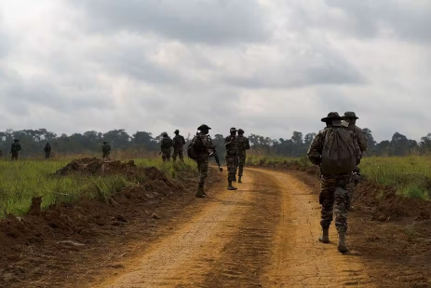
On Oct. 1, 2017, separatists unilaterally declared the independence of a self-proclaimed state they called “Ambazonia,” marking a further escalation of the crisis. Nearly a decade after the initial protests, armed separatist fighters, locally known as “Amba Boys,” continue to clash with government forces in the two regions. UNCONVENTIONAL CONFLICT The war has no frontlines. Armed separatist groups rely on hit-and-run tactics. In response, state security forces have deployed heavily in counter-insurgency operations. “Most parts of the Anglophone regions are no man’s land, meaning nobody clearly has total control over them. In the last 10 years, people simply obey what the military and separatist fighters tell them to do,” said James Ndifor, a political analyst. Civilians have borne the brunt of the conflict, with hundreds of thousands displaced and many others facing persistent insecurity and uncertainty over their return home. More than 6,500 people have been killed since 2016, while over 580,000 people have been internally displaced in the two regions and more than 76,000 have fled to neighboring Nigeria, according to humanitarian sources. ECONOMIC TOLL Since 2017, armed separatist groups have enforced weekly “ghost town” operations, during which businesses, schools and public transport services are ordered to shut down on Mondays. The restrictions have at times been accompanied by armed clashes and other security incidents. It began as a tactic of resistance. Today, many say it is sustained through fear. “If you don’t respect ‘ghost town’, they can burn your business premises. This is costing the country millions of dollars. Many small to medium-sized businesses decided to close because of the losses they incur during the lockdown. To date, residents continue to respect ghost town and stay home on Mondays,” said Johnson Wambo, a businessman resides in the Northwest. The economy of the regions, once driven by the state-run Cameroon Development Corporation (CDC), the country’s major agro-industrial company, and rich cocoa and coffee farms, is struggling to survive.
Since 2017, separatist fighters seeking to paralyze government plantations and cut off revenue have carried out numerous attacks on the company, killing and abducting some of its workers, according to security reports by local police. Thousands of hectares of the CDC’s plantations have been affected, leaving many young people unemployed. DECADE OF DISRUPTED EDUCATION The start of each school year remains “a nightmare” for teachers, students and their families in the two regions. Separatist groups have repeatedly imposed lockdowns and enforced school boycotts to disrupt the reopening of schools, threatening and attacking teachers, students and parents who defy their orders. “It is a very disturbing situation because schools have become battlefields. Teachers and students are regularly kidnapped or killed. Some children who dropped out of school when the crisis began a decade ago have never returned,” said Judith Maya, an educationist in Cameroon‘s English-speaking regions. In a June 2025 report, the United Nations Children’s Fund (UNICEF) said the prolonged crisis had seriously disrupted education in Cameroon‘s Northwest and Southwest regions, with 41 percent of schools non-operational and nearly 224,000 children out of school. But there is hope. Despite the challenges, some former separatist fighters have chosen a different path and have become advocates for education. According to Cameroonian authorities, more than 2,000 separatist fighters have surrendered since 2017.
Over half have either resumed school or taken up vocational training, progress officials view as a milestone in restoring peace and safeguarding the right to education. “The students I teach today can never fall into the same trap I fell into because I tell them my story. Despite once fighting, I now encourage the same children to go to school. I don’t just preach it, I practice it,” said Ateasong Beltus Tajoah, a former fighter who now teaches at a secondary school. ONGOING DIALOGUE Diplomatic efforts to end the conflict have made limited progress, with mediation initiatives stalled amid entrenched positions and ongoing violence. In 2019, the government held a major national dialogue and subsequently granted a “special status” to the two regions, providing for regional assemblies and greater autonomy. It also pardoned hundreds of detainees and launched reconstruction plans. However, the dialogue did not resolve the differences between the government and separatist groups, which continued to call for the establishment of an independent state.
Many of the separatist leaders, including those in exile or in prison, did not participate in the talks. From late September to October of this year, Prime Minister Joseph Dion Ngute toured the two regions to initiate what he called “community dialogue” to end the conflict. The initiative is still in progress. “Every effort is being made to restore lasting peace to our regions. We need to talk and convince these children, our children, the separatist fighters, to drop their arms and embrace peace,” Ngute said during a meeting in Bamenda, chief town of the Northwest region. On the ground, the separatist movement itself has fragmented into many rival groups, often fighting each other for territory and resources, making any ceasefire negotiation even more complex. On a normal day in Bamenda, life appears normal, with businesses operating, taxis and commercial motorcycles running, and people going to work, but beyond that normalcy is a population facing trauma and the scars of conflict and yearning for its end. “We just want peace, peace. We want our lives back. Ten years of suffering is enough,” said Emmanuel Mbah, a resident of Bamenda.
Xinhua


