

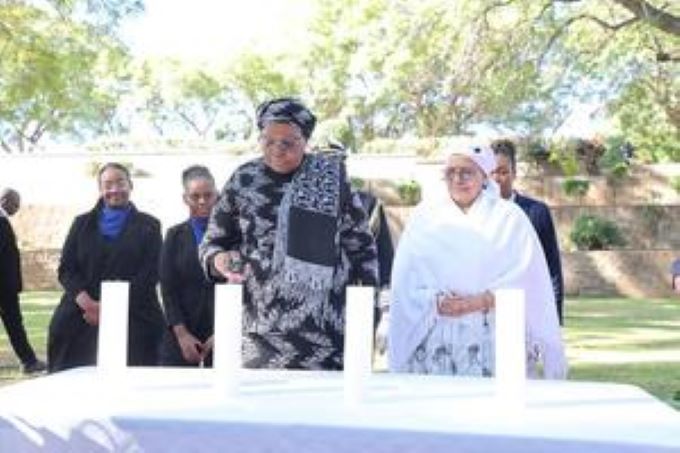
Windhoek, May 30 — Namibians, both at home and in the diaspora, solemnly mark the remembrance of a dark chapter in their national history—a genocide carried out by German colonial forces between 1904 and 1908. The punitive military expeditions escalated into a full-scale campaign of total extermination, targeting Namibia’s indigenous Herero and Nama communities, with no exceptions made for women and children. An estimated 50,000–65,000 Herero and 10,000 Nama were killed during this period, making it the first genocide of the 20th century.
For descendants of the victims, such as Thrive Vinomaandero Mahua, the pain and loss are not distant memories but enduring and painful scars. A proud representative of both the OvaHerero and Nama communities, Mahua has emerged as a leading voice breaking the wall of silence, demanding recognition, justice, and reparations from Germany. “It was only after Namibia’s independence that many displaced individuals were able to reconnect with their relatives.” However, many remain scattered across countries like Botswana.
Germany only formally acknowledged the genocide in 2021 under due pressure, more than a century after the atrocities were committed. However, negotiations between the two governments over reparations have since stalled. The transition to a new government in Germany has only deepened the uncertainty about whether meaningful dialogue will resume.
Mahua expressed her frustration over the prolonged impasse and criticized a proposed €1.1 billion aid package, which was rejected by traditional Herero and Nama leaders. The stance is clear: the funding must go directly to the descendants of the victims, rather than being allocated to general national development projects, as there is concern that such funds may not reach the actual descendants and rightful heirs of those who suffered.
“No monetary figure can truly compensate for the suffering inflicted,” Mahua emphasized. “What is the price of a life?” She added that no amount of aid can console the trauma endured by those who survived, nor the generations that continue to carry the emotional and cultural burden of genocide. Mahua also highlighted the hypocrisy in Germany’s recognition of its genocidal past. While the Jewish community was compensated for the Holocaust committed by the Nazis, she questions what justice has been served for the murders of Namibians.
Post-World War II, the German government has paid billions of dollars in reparations to Holocaust survivors. Between 1952 and 2020, Germany paid more than €70 billion (about $80 billion USD) in reparations through various agreements.
“The Namibian genocide deserves the same level of recognition and accountability as the Holocaust,” she said, noting that many of the brutal tactics employed by Nazi Germany had their roots in colonial Namibia—including the use of concentration camps and medical experiments on racialized subjects. “It is inconsistent to take full responsibility for one atrocity while treating another with markedly less seriousness.”Genocide
The genocide began with an uprising in January 1904, when the Herero, led by Chief Samuel Maharero, rebelled against German colonial rule. Initially successful operation killing over 130 German colonial settlers, their forces were eventually cornered at the Waterberg Plateau. Under the ruthless command of Lieutenant General Lothar von Trotha.
Trotha’s infamous “extermination order,” issued on October 2, 1904, declared that every Herero, armed or unarmed, was to be shot dead. Survivors escaped into the Omaheke Desert, an arid place where many died of thirst and starvation. Those who were captured were imprisoned in concentration camps like the notorious Shark Island, where appalling conditions and human experiements resulted in a mortality rate of up to 74% of natives.
In 1905, under Kaptain Hendrik Witbooi the Nama also rose in resistance, only to suffer a similar fate. German forces responded with equal brutality, resulting in thousands of deaths and the forced incarceration of those who survived.Fight for Justice
Today, descendants of the Herero and Nama continue to seek justice. For Mahua and many others, remembering the genocide is more than a symbolic act—it is a call to conscience, a demand for historical accountability, and a plea for restorative justice.
“We must not allow the world to forget,” Mahua said. “Genocide Remembrance Day must be observed, discussed, and taught at schools. We need to make it uncomfortable, to keep speaking out until there is a meaningful response.”
As Namibia honors the memory of the tens of thousands who were killed, it also underscores a broader message: the fight for recognition, justice, and reparations continues. The genocide in Namibia was not just a tragedy of the past; it remains a moral imperative of the present for every Namibian.
Source: Namibian Times


