


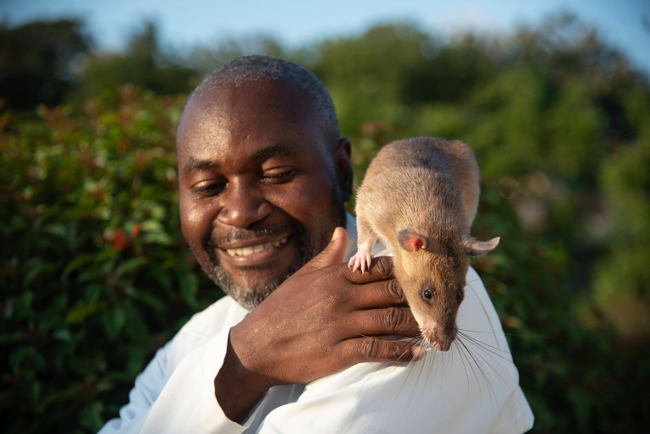
MOROGORO, Tanzania, Aug. 25 — At the foot of eastern Tanzania’s Uluguru Mountains, unlikely heroes are in training to sniff out some of the world’s toughest problems. Meet the African giant pouched rats — modest in size yet gifted with an extraordinary sense of smell.
At the Apopo Detection Rat Training and Research Center at Sokoine University of Agriculture (SUA) in Tanzania’s Morogoro Region, the rodents are being trained to detect landmines, tuberculosis, trafficked wildlife products and even people trapped beneath collapsed buildings. Among those helping transform the animals’ natural ability into a lifesaving tool is trainer Richard Emily, who has worked with the rats for about four years alongside more than 30 trainers and researchers involved in different Apopo projects.
“My passion is to train these rats to save human lives. Their work is beyond words,” said Emily, clad in a T-shirt emblazoned with the words “Apopo saves lives.”The center, located about 200 km west of Tanzania’s commercial capital, Dar es Salaam, is part of Apopo’s wider effort to develop rats capable of tackling some of society’s most pressing challenges.
Apopo, originally a Dutch acronym for “Anti-Personnel Mine Detection Product Development,” was registered in Belgium in 1997. The project focused on landmine detection before expanding into tuberculosis detection, search and rescue, and, more recently, wildlife trafficking. Said Mshana, research and data coordinator for the Apopo project at SUA, said the idea of using the African giant pouched rat for detection came from Belgian product engineer Bart Weetjens, who initially searched for an affordable solution to the landmine problem in sub-Saharan Africa.
After discovering the rats’ remarkable sense of smell, Weetjens wondered why they could not be trained to detect landmines. That eventually led to research and the development of a system for training rats. Training a detection rat is a lengthy process. It begins when the animals are just four weeks old, around the time their eyes first open. Trainers start by gradually exposing the rats to people and unfamiliar environments, so they grow comfortable outside their usual surroundings. Trainers then introduce the rats to a clicker. Paired with food rewards, the click teaches the rats which sound means a treat. Over time, it becomes a communication tool trainers use to shape behavior.”For a landmine detection rat, it takes about nine months to a year to fully train,” Mshana said.
At SUA, wildlife detection rats have already shown promising results by successfully identifying trafficked wildlife products during training. The next step is operational deployment, with Apopo hoping to work with authorities to introduce the rats at strategic locations such as seaports, airports and border crossings. At the same center, researchers are training them to locate people trapped beneath rubble following disasters such as earthquakes and landslides. Recently, six rats were sent to Türkiye in cooperation with Turkish volunteer organization GEA to help researchers assess their performance in real operational environments.
The rats were not yet fully deployed in rescue operations. Instead, the mission was intended to give them experience in real disaster scenarios and help researchers understand their potential for future deployment. Mshana believes Tanzania could eventually become a global center of excellence for training African giant pouched rats. “These rats are trained in Tanzania, at Sokoine University of Agriculture, and then the technology goes out into the world to help save lives in other countries,” he said. There are, however, challenges.
The rats are native to sub-Saharan Africa and may not be suited to extremely cold or hot environments, meaning climatic conditions must be considered when deploying them abroad, said Mshana, adding that funding is also a challenge because many projects depend on donor support. Animal welfare remains a central priority. The rats receive nutritious food, exercise and regular health checks, while their working hours are limited to prevent excessive strain. “When they become too old to work, fall ill or reach retirement age, they are transferred to a dedicated retirement unit, where they continue receiving food, exercise and daily care,” explained Mshana.
One of Apopo’s most celebrated rats was Magawa, a giant pouched rat internationally known after detecting numerous landmines and receiving a gold medal for his achievements. Magawa retired in Cambodia and later died. Today, about 240 rats are housed at the facility at different stages of training. Some tuberculosis detection rats are trained at another Apopo facility in Dar es Salaam, with plans underway to establish another tuberculosis detection clinic in the northern Tanzanian city of Arusha. From the forests surrounding the Uluguru Mountains to disaster zones thousands of kilometers away, Tanzania’s giant pouched rats are demonstrating that lifesaving innovation can come in an unexpected form. “After working with Apopo and working closely with the rats, I am very confident that this technology can be used anywhere to save lives, as long as the rats are trained for that particular job,” Mshana said.
Xinhua proud partner of the African Youth Newspaper


