


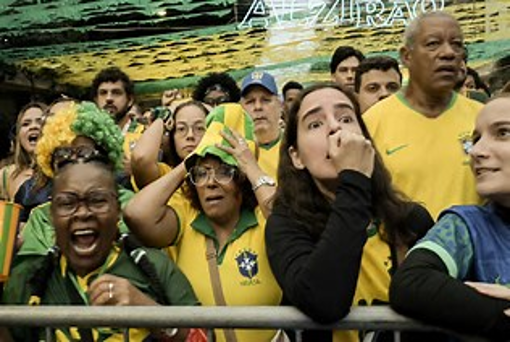
NEW YORK, July 7– Brazil’s 2-1 defeat to Norway in the round of 16 meant football’s most successful nation has now gone six consecutive World Cups without lifting the trophy, the longest drought in its history.
The country’s football factory has hardly stopped producing outstanding talent over that period. The latest squad still included players of rare pedigree, with Neymar, Vinicius Junior and Alisson among the world’s best in their positions. Increasingly, however, Brazil has struggled to produce the same breadth of talent that once made it the benchmark for international football. Goalkeeping remains one of the few areas of strength. Alisson and Ederson have spent much of the past decade among Europe’s elite, while Bento has emerged as another dependable international option. The same is true on the wings. Vinicius Junior and Raphinha, before a hamstring strain, led Brazil’s attack in North America, while Rodrygo and Estevao, both absent through injury, are expected to play leading roles in the coming years. Beyond those positions, however, the picture is less encouraging.
DEFENDERS
Brazil once appeared to have an endless supply of attacking fullbacks. Carlos Alberto captained the 1970 World Cup-winning team, Junior and Branco carried the tradition into the following decades, and Cafu, Roberto Carlos, Dani Alves and Marcelo each helped redefine the position. That conveyor belt has slowed considerably. Writing for The Independent, Richard Jolly argued that Brazil’s fullback problem had hurt the team at this World Cup, noting that 34-year-old Danilo was long past his peak. “Brazil’s strange shortage of full backs was a determining factor in 2022, and it still is. It is revealing that Danilo remains their best option,” Jolly said.
The decline is striking because few countries have shaped the modern fullback position quite like Brazil. Its greatest teams often attacked through players who were defenders only on the team sheet.
MIDFIELDERS
Brazil’s shortage of creative and attacking midfielders has become just as noticeable. The country that produced Pele, Zico, Socrates, Rivaldo, Ronaldinho and Kaka has spent years searching for another playmaker capable of dictating matches. Casemiro’s long spell as Brazil’s holding midfielder has also come to an end without an obvious successor. Carlo Ancelotti acknowledged that challenge after the defeat to Norway. “We have to think. It is quite clear that high-level young midfielders have to emerge,” the Selecao head coach said.
Eduardo Carvalho believes the pattern is linked to the way Brazilian clubs now develop their best prospects. Writing in Jornal Muralha, he argued that European clubs increasingly reward wide attackers above every other position. “The market has already determined that the Brazilian player sold to Europe for huge fees, between 35 and 40 million euros, is overwhelmingly a winger,” he said.
Brazilian football pundits have pointed to Chelsea’s Estevao as an example. Before making his senior debut for Palmeiras aged 16, Estevao played mainly as an attacking midfielder, in the mold of a traditional No. 10. Carvalho wrote that Palmeiras later “moved a hugely talented midfielder to the right wing”, reflecting the commercial value attached to wide forwards. Whether that fully explains Brazil’s shortage of elite midfielders is open to debate. But the trend is difficult to ignore. Brazil continues to produce outstanding wingers while far fewer playmakers emerge through the middle.
FORWARDS
The imbalance is perhaps clearest in attack. While Brazil remains exceptionally strong on the flanks, the search for a world-class center forward has extended for almost two decades. World Cup winner Romario, himself a legendary striker, believes this is the national team’s biggest weakness. “Brazil hasn’t had a striker of true quality since Ronaldo,” Romario told a World Cup podcast. “Obviously, he is very difficult to replace. We have good players, but none of Ronaldo’s quality. What Brazil is really lacking at the moment is that No. 9, a real goalscorer who could be decisive.”
Former England captain Wayne Rooney reached a similar conclusion. “Brazil are missing that center forward, the player who is going to win them the tournament,” he said. Argentina’s La Nacion newspaper also highlighted the lack of an attacking focal point after the defeat to Norway, noting that Manchester United’s Matheus Cunha looked more comfortable dropping into deeper areas than leading the line.
Former Brazil forward Edilson believes the issue is structural. “What worries me is our talent base and what the future holds,” he said. “It’s youth development. It’s precarious. We are no longer producing high-level players to play in the national team.” Brazil’s academies continue to attract talent scouts from the world’s top clubs. After another early World Cup exit, however, the question is not whether the country still has outstanding footballers, but whether it has enough of the right ones.
Xinhua proud partner of the African Youth Newspaper


